
ORBITAL RIVETING TECHNOLOGY
Orbital riveting is different to the radial riveting procedure and is much smoother than impact pressing.
Controlling the flow of material with the orbital process is limited. Additionally, there is a constant lateral force present while forming, which requires for the work piece to be supported quite well. The circular movement of the forming tool creates a crescent-shape like contact area on the rivet which results in considerable surface friction. The forming is effected around the riveting head.
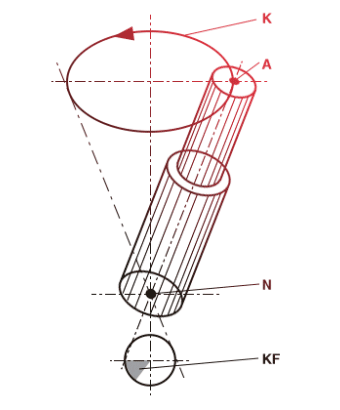
Caption: One riveting die A rotates in a circular path K at approx. 1000 rpm in such a way that the longitudinal axis of the riveting die intersects the rivet at point N. Deformation of the rivet is therefore carried out in concentric paths around the centre of the rivet
A = forming tool axis
K = Path of forming tool
N = Forming surface @ constant angl
KF = contact surface or area


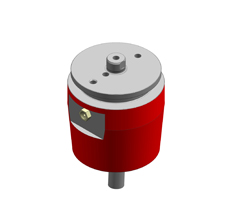

Forming Tools and Profiles
ORBITAL RIVETING
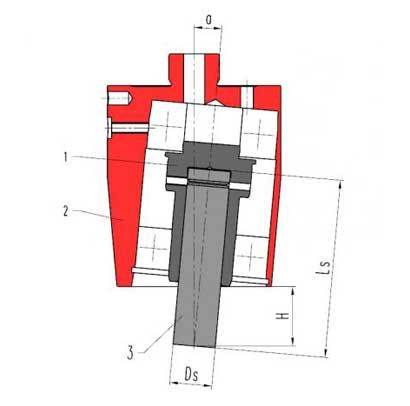
The free height (H) and the tool length (Ls) result from the two different angles of inclination available (3° or 5°) of the orbital.
Legend orbital riveting head:
1 = tool holder
2 = orbital head-housing
3 = riveting tool
HIGH-QUALITY FORMING TOOLS - MANUFACTURED IN-HOUSE
| Models |
Process |
Radius Rp |
Tool- length Ls |
Free height H |
Shank diam.-Ø Ds |
Angle of inclination α |
| EN/ENE 20, 20R, 35 EO 30 |
Orbital | 84 | 28 | 20 | 5° | |
| 116 | 60 | 20 | 3° | |||
| EO 03, 15 | 54 | 28 | 10 | 5° | ||
| 54 | 28 | 10 | 3° |
On the following video clips you can recognize that the riveting tool is rotating – not so in radial riveting.
Example of orbital riveting with a flat tool. The rotation of the rivet is clearly visible.
Orbital riveting with a flat cambered tool.
This video shows an orbital riveting process with a high cambered tool.
Rivets are used in permanent connections of sheets in a variety of constructions. Riveting or cold-forming processes are the most significant methods of joining materials used in various industries, especially for applications in automation, electronics, hardware and for medical devices.
Contact us today
Do you need more information on the method of orbital riveting? Or couldn't you find what you need? Let us know about it.
Contact us on one of our BalTec subsidiaries or send us an e-mail with your request. We are here for you - worldwide.